

1.FCVI Cycle–Powered Creation of a World-Leading Energy Research and Education Hub
FCVI Cycle is an innovative research promotion model that integrates prediction, analysis, assessment, and implementation support to advance innovative future energy technologies originating from Kyushu University. By gathering and combining knowledge from diverse academic fields, we identify and incubate technologies essential for future society, while establishing the academic foundation for a decarbonized society.


2.FCVI Promotion Modules
With the goal of establishing a world-leading center for energy research and education, we are developing the “FCVI Promotion Modules” based on the FCVI cycle.
FCVI Promotion Module-C
(Analysis of the Impact of Introducing Innovative Technologies into Cities)
This module drives simulations of introducing new technologies into cities within Function-C of the FCVI cycle (Coupled Analysis of Contribution to Decarbonization).
Research outline
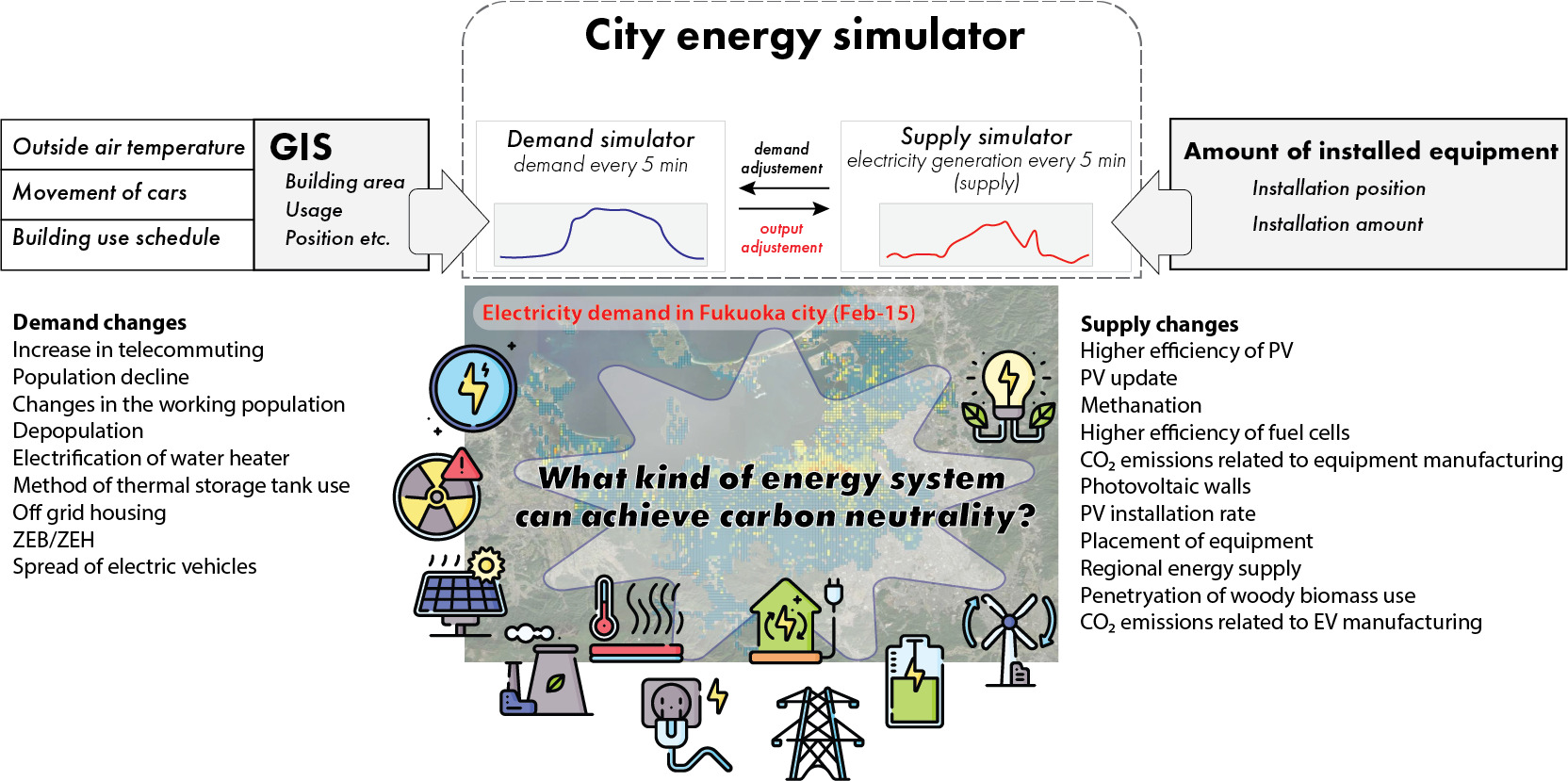
In order to realize a carbon-neutral society by 2050, the government is aiming to make variable renewable energy sources such as photovoltaic panel and wind power generation the main source of electricity. To achieve this goal, it will be necessary to increase the electrification ratio on the building side, adjust electricity supply and demand through storage batteries (including EV batteries) and demand response, and utilize hydrogen. In order to study how much of these devices and systems should be installed in a city, it is essential to have an urban energy simulator that can not only calculate the total annual amount, but also analyze energy supply and demand fluctuations by the minute. In this module, we will construct an urban energy supply-demand simulator based on GIS data as a platform that can examine future urban energy systems, and propose what the future urban energy system should be like. This simulator will be used to analyze the potential impact of widespread adoption of various research and technology seeds that contribute to urban decarbonization.
Research originality
This research is unique and different from previous studies in that it can analyze the energy demand of individual buildings, areas, and even the city level, including energy peaks, with calculations at five-minute intervals. Another novel aspect is the incorporation of transportation energy into urban energy calculations in anticipation of the future connection of electric vehicles to the grid.
Module members
SUMIYOSHI Daisuke

Module Leader
Professor
Faculty of Human-Environment Studies
Overall supervision, simulator development
KUROSE Takefumi

Professor
Faculty of Human-Environment Studies
Urban Model Study Group
SHIGA Tsutomu

Associate Professor
Faculty of Human-Environment Studies
Urban Model Study Group
ARIMA Yusuke

Assistant Professor
Faculty of Human-Environment Studies
Urban Model Study Group
SUEHIRO Kaoru

Professor
Faculty of Human-Environment Studies
Architectural Future Vision Study Group
SUEMITSU Hirokazu

Associate Professor
Faculty of Human-Environment Studies
Architectural Future Vision Study Group
KANNO Tatsuo

Professor
Faculty of Human-Environment Studies
Urban Resilience Study Group
YAMAGUCHI Kentaro

Professor
Faculty of Human-Environment Studies
Urban Resilience Study Group
FCVI Promotion Module-V
(Life Cycle Value Assessment of Innovative Technologies Including Manufacturing Processes)
This module advances Life Cycle Assessment (LCA) within Function-V of the FCVI cycle (Value Assessment).
Research outline
This study focuses on durable products such as passenger cars and addresses the following three research questions. The first question is how life-cycle CO² emissions of durable goods can be reduced through demand-side policies such as product lifetime shifts and environmental subsidy? The second question is how life-cycle emissions of durable goods can be reduced through supply-side policies such as energy and resource efficiency improvements and global supply chain restructuring? The third question is how life-cycle CO² emissions of durable goods can be mitigated through a combined policy with both demand- and supply-side policies? In addressing the above-mentioned questions, we combine the global multi-regional input-output analysis framework with the network data envelopment analysis and develop an integrated analysis framework to evaluate the economic and environmental performance of global supply chain networks of a particular durable product from the life-cycle perspective. From the results, we finally suggest a potential pathway of maximizing CO² reduction potentials of durable goods through strengthening the demand- and supply-side policies.
Research originality
This study develops an integrated environmental assessment framework based on the three modeling techniques of input-output analysis, network analysis, and efficiency analysis. We apply the integrated environmental assessment framework to various environmental burdens such as CO², PM2.5, and toxic chemicals. From the results, we provide policy implications of how the government can efficiently reduce those emissions via the demand- and supply-side policies.
Module members
KAGAWA Shigemi

Module Leader
Professor
Faculty of Economics
Development of integrated evaluation models, data analysis, and policy recommendations
MANAGI Shunsuke

Professor
Faculty of Engineering
Development of integrated evaluation models, data analysis, and policy recommendations
FUJII Hidemichi

Professor
Faculty of Economics
DEA model development, data analysis, and policy recommendations
NAKAISHI Tomoaki

Lecture
Faculty of Economics
DEA model development, data analysis, and policy recommendations
HANAKA Tesshu

Associate Professor
Faculty of Information Science and Electrical Engineering
Network model development, data analysis, and policy recommendations
CHAPMAN Andrew

Associate Professor
International Institute for Carbon-Neutral Energy Research (I²CNER)
Development of energy assessment models, data analysis, and policy recommendations
FCVI Promotion Module-I
(Relational Energy Data Construction and Researcher Network Generation)
This module develops methods of researcher network analysis to support the formation of outstanding research teams within Function-I. (Incubation).
Research outline
Relational energy data is a comprehensive database in which energy-related research data (e.g., published papers) are used as primary sources for finding various relations and links. Energy issues have an inter-/transdisciplinary character. Therefore, they should be tackled from multiple viewpoints, considering that each researcher has a different way of thinking about a goal. Furthermore, since cooperation among researchers is necessary for breakthrough ideas, the feasibility of realizing the ideas depends significantly on the team’s organization toward the goal. Therefore, to organize teams optimally and promptly, a researcher as principal investigator (PI) must quickly find the researchers who focus on the materials, technologies, systems, and theories that match the primary PI’s idea. In this module, as the first attempt, we focus on multiple module studies on CO² and build relational energy data. Finally, we will build a Web tool (Right figure) that automatically generates and visualizes the optimum researcher network.
Research originality
As the output of the Visualization of an object-oriented researcher-net work based on the relational energy data, PI can select the points he/she wants to emphasize in the network generation, such as strong collaboration, high feasibility, etc. The originality of this research exists in this optimization algorithm.
概要図(差し替え)日英共通-1024x549.png)
Module members
TADA Tomofumi

Module Leader
Professor
Platform of Inter-/ Transdisciplinary Energy Research
Project management, database Information Technology design and building, validation and dissemination
YAMAZAKI Yoshihiro

Professor
Platform of Inter-/ Transdisciplinary Energy Research
A provider of data related to the catalytic transformation CO²
YASUTAKE Daisuke

Associate Professor
Faculty of Agriculture
A provider of data related to the CO² utilization in the agriculture
KAGAWA Shigemi

Professor
Faculty of Economics
A provider of data related to the CO² emissions in various areas (industry, infrastructure, residential sector etc.)
INOUE Koji

Professor
Faculty of Information Science and Electrical Engineering
Database check, testing and validation
MURAKAMI Yasukazu

Professor
Faculty of Engineering
Database check, testing and validation
YAMAUCHI Miho

Professor
Institute for Materials Chemistry and Engineering
Database check, testing and validation
MOTOYAMA Munekazu

Associate Professor
Platform of Inter-/ Transdisciplinary Energy Research
Data collection, database support, relations visualization
SELYANCHYN Roman

Associate Professor
Platform of Inter-/ Transdisciplinary Energy Research
Data collection, database support, relations visualization