






Hydrogen production rate via serpentinisation reactions for natural hydrogen development

Research outline

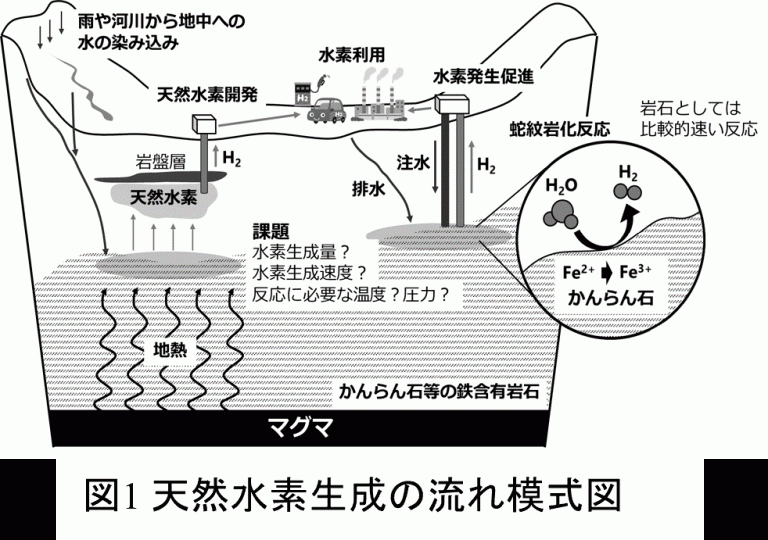
A major challenge in the societal implementation of hydrogen is the cost of hydrogen production. Against this backdrop, natural hydrogen—generated during the serpentinisation reaction, in which olivine reacts with water under high temperature and pressure—is attracting attention. As Japan possesses abundant reserves of peridotite, water and geothermal energy, there is recognised potential for hydrogen production through the injection of water into bedrock; however, a lack of fundamental data—such as the amount of hydrogen generated and the reaction rate—makes it difficult to assess the economic viability of utilising natural hydrogen. This is due not only to the difficulty of synthesising peridotite, which has a high melting point, but also to the technical challenges involved in conducting chemical reaction experiments under high-temperature, high-pressure conditions. In this study, utilising the research expertise of the Sustainable Hydrogen Research Institute, we will synthesise olivine artificially and measure the reaction rates of the chemical reactions that produce hydrogen when it reacts with water under high-temperature, high-pressure conditions. By comparing these results with the mineral and chemical compositions of natural olivine and its hydrogen production rates, we will calculate the effective recoverable reserves and economic viability of natural hydrogen.

Research backgoround

Hydrogen, which is attracting attention as a next-generation energy source, has a low environmental impact as it emits only water upon use, and is regarded as one of the key fuels for realising a decarbonised society. However, as regards hydrogen production, the current methods involve either steam reforming of natural gas or electrolysis of water; consequently, the high cost of hydrogen production remains a major challenge to its widespread adoption.

Research originality

The reason why previous studies have failed to provide insights into the amount and rate of hydrogen production via the serpentinisation reaction is that natural olivine, which contains a high level of impurities, has been used in experiments, making it impossible to isolate the reaction mechanism or determine the precise role of olivine in hydrogen production. In this study, we address this issue by using synthetically produced olivine, thereby elucidating the mechanism of hydrogen production via the serpentinisation reaction of olivine.

Module members

YAMADA Yasuhiro

Professor
Faculty of Engineering

Reserve and feasibility evaluation

SUGAI Yuichi

Professor
Faculty of Engineering

Comparison with natural rock

UMENO Takahiro

Professor
Office for Promotion of Environmental Management

Safety Assessment of High-Pressure Equipment

1

MIYAZAKI Koji

Professor
Faculty of Engineering

Measurement of Chemical Reaction Rates

HASHIKUNI Katsuaki

Assistant Professor
Faculty of Engineering

Synthesis of olivine

ITO Akane

Assistant Professor
Faculty of Engineering

Comparison with natural rock

OYAMA Keishi

Assistant Professor
Faculty of Engineering

Comparison with natural rock

1

Expected results and outcomes of the collaboration

By establishing the fundamental scientific principles for the development of natural hydrogen, we aim to quantify the effective recoverable reserves of natural hydrogen and the cost of producing it through water injection. This will not only contribute to the advancement of natural hydrogen development but also help to build a scientific foundation for the stable supply of hydrogen energy and the sustainable use of resources in the future. In this way, we aim to help many countries and regions around the world achieve societies capable of self-sufficiency in low-environmental-impact energy.

Representative research papers and achievements

九州地域の天然水素ポテンシャルと今後の展望

山田泰広, 加納雅俊, 池田達紀, 石須慶一, 伊藤 茜, 小山恵史, 菅井裕一, ダネカー・シャガエグ, 濱中晃弘, 松本光央.
2026,日本エネルギー学会機関紙えねるみくす
DOI:105, no.4, 456-459

Copyright © 2025 九州大学 エネルギー研究教育機構 All Rights Reserved.