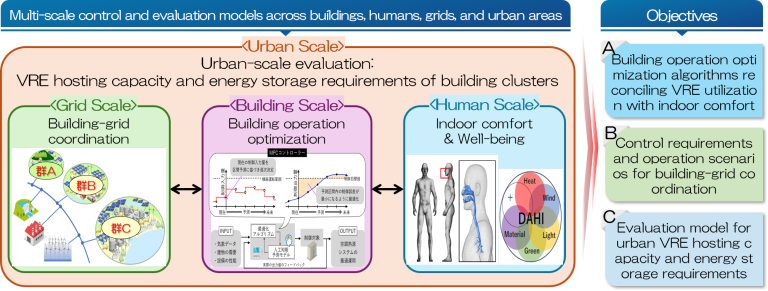





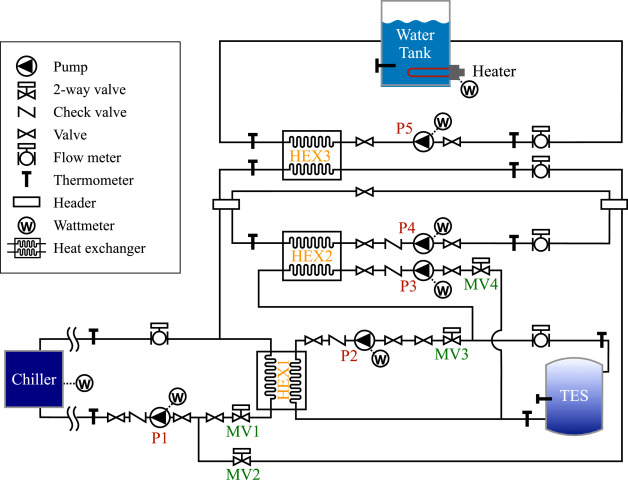
While renewable energy deployment accelerates toward a decarbonized society, solar and wind output is highly variable, and high penetration of variable renewable energy (VRE) requires flexible balancing of electricity supply and demand. The International Energy Agency (IEA) classifies VRE integration into six phases; many countries, including Japan, are approaching the higher phases, which demand fundamental changes in power system operation. In Japan, buildings acting as demand-side resources and urban areas accommodating VRE hold the key to grid flexibility. This, however, requires simultaneously addressing building energy management and occupant well-being, grid coordination, and aggregate effects at the urban scale. This module therefore develops integrated multi-scale control and evaluation models across the building, human, grid, and urban scales, starting from building control, to (A) optimize building operation for both VRE utilization and indoor comfort, (B) identify conditions for building–grid coordination, and (C) evaluate the VRE hosting capacity and energy storage requirements of urban areas.
With the rapid expansion of solar and wind power, Japan is expected to reach the IEA-defined higher phases of VRE integration by 2030; in Kyushu, a front-runner in renewable deployment, challenges such as recurring renewable curtailment have already become evident. Meanwhile, the building sector accounts for about 30% of Japan’s final energy consumption and contains equipment—air conditioning, hot water supply, and thermal and battery storage—capable of shifting demand over time. There is thus a growing need to harness these buildings as flexibility resources for the power grid and to link them to VRE accommodation at the urban scale.
Building environmental analysis and control, grid control, and urban energy simulation have advanced independently at their respective scales, and few studies have bridged these fields. The originality of this module is twofold: it unifies the expertise of these fields under the common goal of VRE accommodation, thereby presenting a novel framework for integrated control and evaluation across the building, human, grid, and urban scales; and it establishes human-centric building operation that extends to occupant well-being.
LEE DOYUN
Associate Professor
Q-PIT
Overall coordination / Task A (Building scale): Development of MPC-based building operation optimization algorithms
SUMIYOSHI Daisuke
Professor
Faculty of Human‐Environment Studies
Task C (Urban scale): Evaluation of urban VRE hosting capacity using a GIS-based urban energy simulator
FARZANEH HOOMAN
Professor
Faculty of Engineering Sciences
Task B (Grid scale): Verification of building–grid coordination based on microgrid expertise
YOO SUNGJUN
Associate Professor
Q-PIT
Task A (Human scale): Development of comfort indices through CFD and indoor environment assessment
This module develops building operation optimization algorithms that reconcile responsiveness to VRE fluctuation with occupant comfort. It further identifies the grid-side control requirements and operation scenarios under which building clusters can function as demand-side resources, and validates them through proof-of-concept studies. Extending these control effects to the urban scale, the module then develops a model that quantitatively evaluates the VRE hosting capacity and energy storage requirements of urban areas.

D. Lee, R. Ooka, Y. Matsuda, S. Ikeda, W. Choi.
Sustain. Cities Soc., 79, 103700 (2022)
DOI:10.1016/j.scs.2022.103700
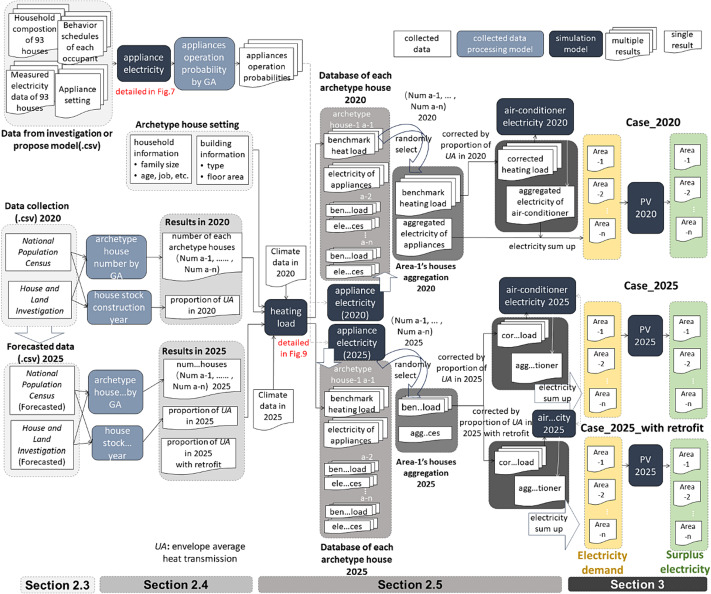
H. Wang, D. Sumiyoshi
Appl. Energy, 363, 123043 (2024)
DOI:10.1016/j.apenergy.2024.123043
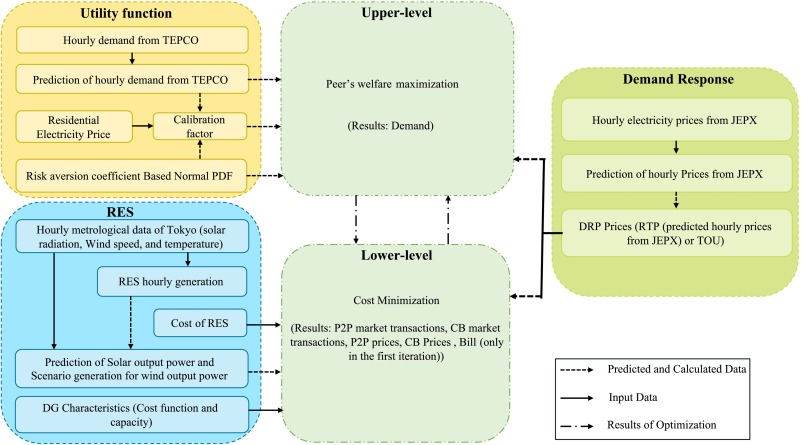
M. Moradi, H. Farzaneh
Appl. Energy, 390, 125806 (2025)
DOI:10.1016/j.apenergy.2025.125806

S. Yoo, K. Ito
Adv. Build. Energy Res., 14(2), 171–188 (2020)
DOI:10.1080/17512549.2019.1588167

有馬雄祐, 宗方淳, 伊丹弘美, 中村知靖
日本建築学会環境系論文集, 90(834), 348–359 (2025)
DOI:10.3130/aije.90.348