



This module seeks to develop an integrated framework for the design, construction, and management of housing improvement projects targeting low-income populations in developing countries, such as urban slum upgrading initiatives. The objective is to realize decarbonized, safe, and thermally comfortable living environments that ensure high levels of resident satisfaction, even under severe cost constraints. In response to the structural deficiencies, inadequate indoor thermal performance, insufficient ventilation and daylighting, and sanitation challenges commonly observed in substandard housing, the module fosters interdisciplinary collaboration among experts in structural engineering, environmental engineering, wind engineering, and educational sciences. Together, they aim to address broader issues such as the well-being of residents—particularly children—and the formation of cohesive communities, thereby establishing a sustainable implementation model. By shifting the focus of decarbonization research—currently dominated by cases in developed countries—this initiative aims to provide a critical counterpoint and contribute to the promotion of urban sustainability and improved living conditions in resource-constrained settings with high concentrations of low-income populations.
Developing countries account for about 70% of global greenhouse gas emissions, with emissions rapidly increasing particularly in emerging nations such as Indonesia. Meanwhile, the rapid urbanization in these regions has led to the expansion of informal settlements, which has become a serious social issue. In affordable housing for low-income populations in developing regions, there is a need to develop strategies that simultaneously achieve improved quality of life, health and safety assurance, and low-carbon/decarbonization goals.
This module aims to improve the seismic resistance, ventilation, and thermal performance of affordable housing by integrating knowledge from structural engineering, environmental engineering, and wind engineering, while also utilizing educational insights to present models for inclusive and sustainable living for diverse populations. Such comprehensive interdisciplinary collaboration is unprecedented and represents a theme with high academic and social impact potential that aligns with global trends toward achieving SDGs and a decarbonized society.
YAMAGUCHI Kentaro
Professor
Faculty of Human-Environment Studies
Structural integrity assessment and standardization of construction management practices
KINOSHITA Hiroko
Associate Professor
Faculty of Human-Environment Studies
Investigation of residents’ lifestyles with a focus on children and identification of factors influencing satisfaction with the living environment
HAGISHIMA Aya
Professor
Faculty of Engineering Sciences
Coordination of indoor thermal and air quality assessments, evaluation of energy-saving technologies, and field surveys
IKEGAYA Naoki
Professor
Faculty of Engineering Sciences
Ventilation performance assessment of dwellings based on wind tunnel experiments and CFD analysis
The city of Surakarta, Indonesia, will serve as the primary field site for this study. Focusing on low-rise housing for low-income populations, the project aims to develop a set of design and construction guidelines that simultaneously ensure structural safety, reduce energy consumption, mitigate heat-related health risks, and enhance residents’ satisfaction with their living environment. Furthermore, through dialogue and collaboration with relevant stakeholders, the project will propose an implementation process for these guidelines. The insights gained will also be leveraged to inform demonstration projects and facilitate horizontal dissemination to other cities and countries.

Murtyas, S.; Handayani, K. N.; Sho, K.; Hagishima, A.
Urban Science 2025, 9 (4), 131.
DOI:10.3390/urbansci9040131
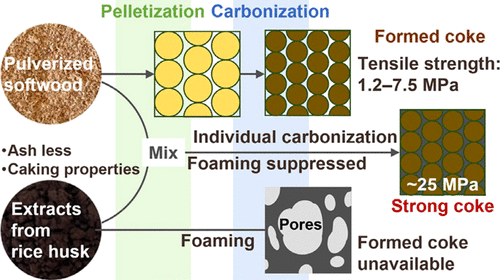
Shogo Okida, Hirotsugu Dohi, Shinji Kudo, Shohei Wada, Takahiro Shishido, Noriyuki Okuyama, Shusaku Asano, Jun-ichiro Hayashi.
Energy Fuels, 38 (2024) 16532.
DOI:10.1021/acs.energyfuels.4c02892
Murtyas, S.; Minami, Y.; Handayani, K. N.; Hagishima, A.
Buildings 2023, 13 (5), 1333.
DOI:10.3390/buildings13051333
Murtyas, S.; Hagishima, A.; Kusumaningdyah, N. H.
Building and Environment 2020, 184, 107239.
DOI:10.1016/j.buildenv.2020.107239
Hirose, C.; Ikegaya, N.; Hagishima, A.; Tanimoto, J.
Building and Environment 2021, 196, 107811.
DOI:10.1016/j.buildenv.2021.107811