Data science-based interdisciplinary academia-industry collaboration
Research outline
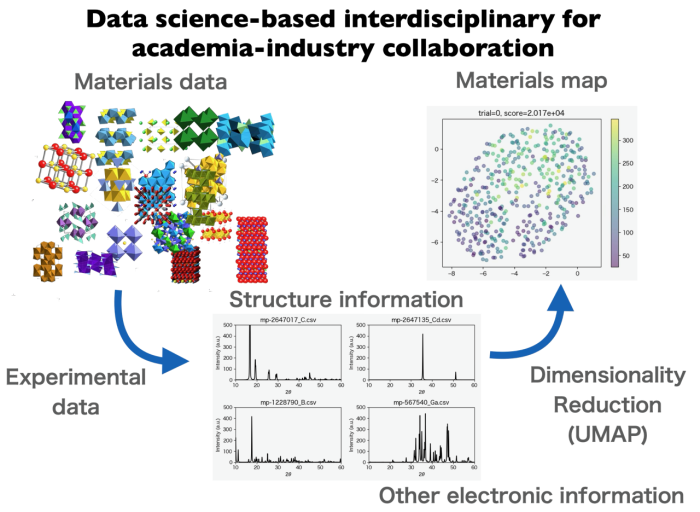
In order to achieve carbon neutrality by 2050, renewable energy is required to become the main source of electricity. We use computational science as a tool to participate in research and development projects related to renewable energy. This research plan brings together young researchers in the materials science and engineering, and forms a base for materials research that contributes to carbon neutrality. To this end, we will develop an integrated material database that can be used in various materials research fields, support joint research between young researchers, and aim to create new comprehensive knowledge. We will also work with related technology, such as Toyota Motor Corporation’s WAVEMAP, to implement it in society through comprehensive collaboration with industry.
Research backgoround
Materials development research requires the synthesis of substances and materials based on theory, experience, and intuition, and the repeated evaluation of their structure and physical properties to optimize them, and it was previously thought that it would take a long time, spanning 10 to 30 years, before they could be put to practical use. In recent years, the search for more efficient material development methods has begun around the world, and the emergence of new material development methods based on increased computing power and highly accurate algorithms such as density functional theory has attracted particular attention.
Research originality
The way forward for materials science research in the midst of the increasingly fierce development race is to (1) integrate multiple research fields and (2) build a materials database that can quickly and cheaply screen materials by combining data science and experimental data that takes advantage of Japan’s strengths, and to devise a unique comprehensive development method. To this end, we would like to promote collaboration within the Department of Advanced Materials Science and Engineering, Faculty of Engineering Sciences, and build a cooperative relationship with Toyota Motor Corporation, which has a materials exploration platform called WAVEMAP.
Expected results and outcomes of the collaboration
We will begin with collaboration within the Faculty of Engineering Sciences, and in the future, by collaborating with related departments such as the Faculty of Engineering and the Institute for Materials Chemistry and Engineering, it will be possible to advance research and development of technology that utilizes material databases in multiple ways. Externally, we will strengthen our collaboration with Toyota Motor Corporation and build a collaborative research system with other material companies and a collaborative system with related academic societies.